Area: 30 Acres
Location: Lathrop, San Joaquin County, CA
Date Acquired: 2004
Acquisition Type: CNLM owns the preserve. We protect and manage imperiled species and habitats on the preserve in perpetuity
Key Habitats: Valley Foothill Riparian
Species of Special Interest to CNLM: Riparian brush rabbit (Sylvilagus bachmani riparius), Swainson’s hawk (Buteo swainsoni), Valley Elderberry Longhorn Beetle (Desmocerus californicus dimorphus)
Introduction
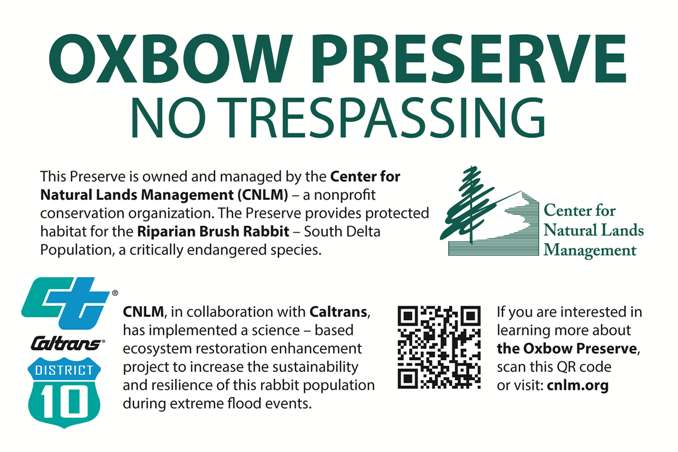
The Oxbow Preserve was initially created in 2004 by Union Pacific Homes as mitigation for the adjacent development in the City of Lathrop. This 30-acre Preserve was established to protect the state and federally endangered riparian brush rabbit (RBR; Sylvilagus bachmani riparius). The Center for Natural Lands Management (CNLM) took ownership of this Preserve in 2004.
Our Work
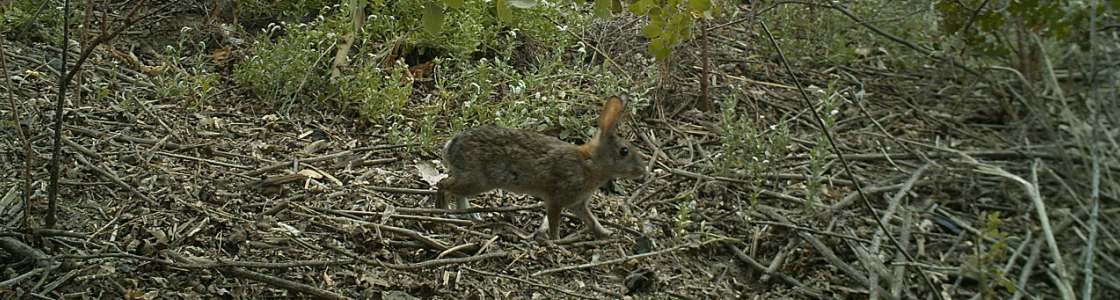
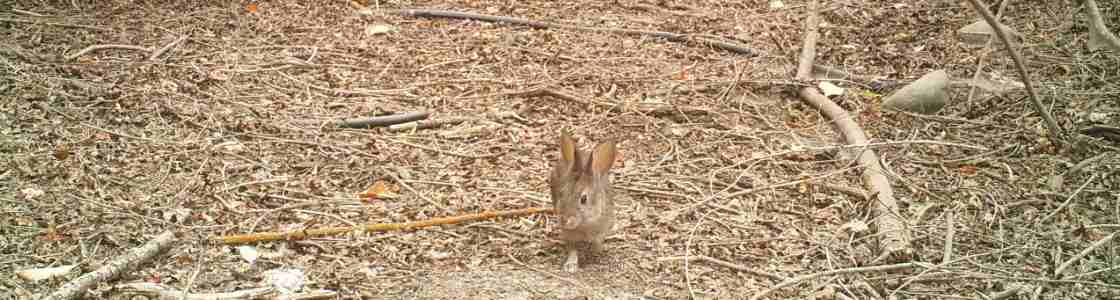
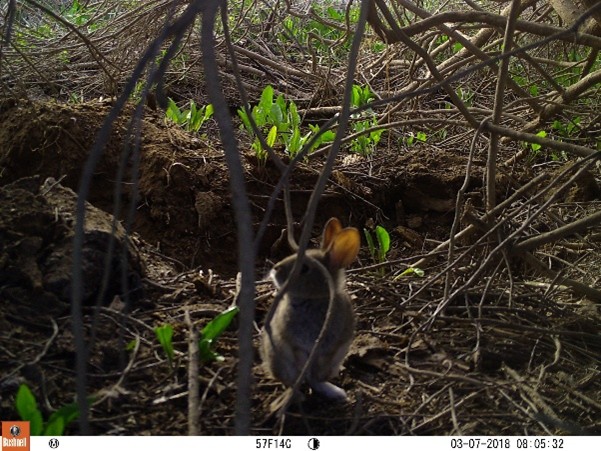
CNLM primary goal is to protect the riparian brush rabbit population and its native habitat. CNLM monitors the Preserve’s conditions including addressing trespass violations, monitoring exotic predators (e.g. feral cats), changes/trends in vegetation and vandalism, removing trash and debris, repairing gates, fences, and signs, and controlling exotic invasive plants. In addition, our activities include coordinating access to the Preserve for outside researchers and monitoring Riparian brush rabbit populations through the use of remote motion activated cameras.
Conservation Significance
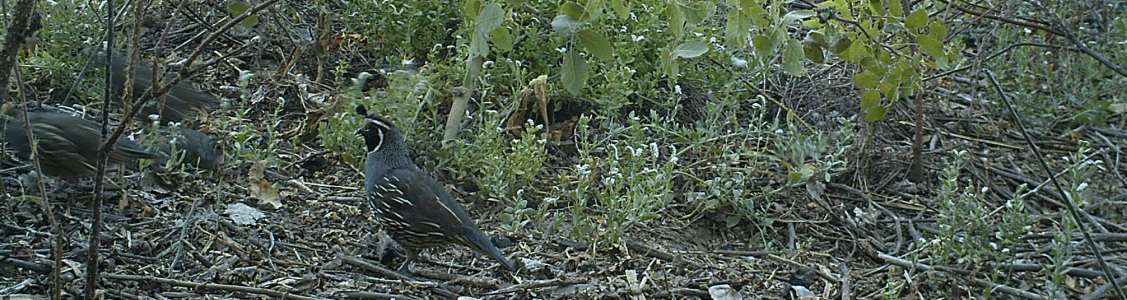
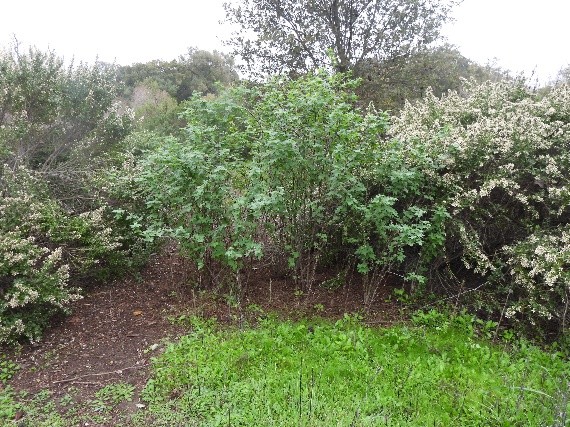
The Preserve provides critical habitat for the South Delta population of riparian brush rabbit and is one of only a few remaining sites within the San Joaquin watershed that have populations of this endangered species. This Preserve is comprised of mixed-age riparian forest located adjacent to the San Joaquin River. Valley oaks (Quercus lobata), cottonwoods (Populus fremontii), willows (Salix spp.), elderberry (Sambucas nigra ssp. caerulea), California blackberry (Rubus ursinus) and wild rose (Rosa californica) are common within the Preserve. Low lying dense vegetation provides shelter and protection for RBR. Grass and forbs, such as mugwort (Artemesia douglasiana) and gumplant (Grindelia camporum), provide forage for RBR. The Preserve also provides habitat for Valley Elderberry Longhorn Beetle (Desmocerus californicus dimorphus) and the state threatened Swainson’s hawk (Buteo swainsoni). More than 75 species of birds have been identified within the Preserve.
Historically, RBR occurred in riparian corridors within the floodplain of the San Joaquin River and its tributaries. While the species was well adapted to periodic flooding, this required large continuous areas of suitable habitat linking floodplains to higher ground to provide for movement in response to rising flood waters. RBR habitat has now been severely restricted and fragmented due to development and agriculture which has severely limited the species’ ability to disperse and find refuge during flooding. They are now one of the rarest mammals in California, with limited small, disjunct populations distributed in a narrow range along the San Joaquin River (Bonham, 2020). The largest extant RBR population and largest area of suitable habitat is at the San Joaquin River National Wildlife Refuge (SJRNWR), where RBR were reintroduced in 2002, and the nearby Caswell State Park, which has a natural population. Oxbow Preserve represents one of the South Delta populations. The South Delta populations are small, isolated, naturally occurring groups of RBR located north of the Refuge complex along the lower San Joaquin River. Although these South Delta populations are limited in size and vulnerable to flooding, habitat loss, and demographic stochasticity, they collectively contribute unique genetic diversity and play a critical role in maintaining the species’ redundancy and representation, which are key components of long-term recovery.
Threats
The Oxbow Preserve lies within the floodplain of the San Joaquin River, with most of the land consisting of low-lying riparian woodland and an elevated manmade berm bisecting the property. The berm presents the only available land mass for RBR and other animals to find refuge when floodwaters rise. Therefore, the primary threat to the RBR population at the Preserve is extreme flooding events. Until recently, the raised berm, which provides the only high-ground on the Preserve, lacked any substantial vegetation or cover for the rabbits during high water events, exposing them to increased predation Unfortunately, these extreme flood events are not infrequent – the most recent being in 1997, 2017 and 2023.
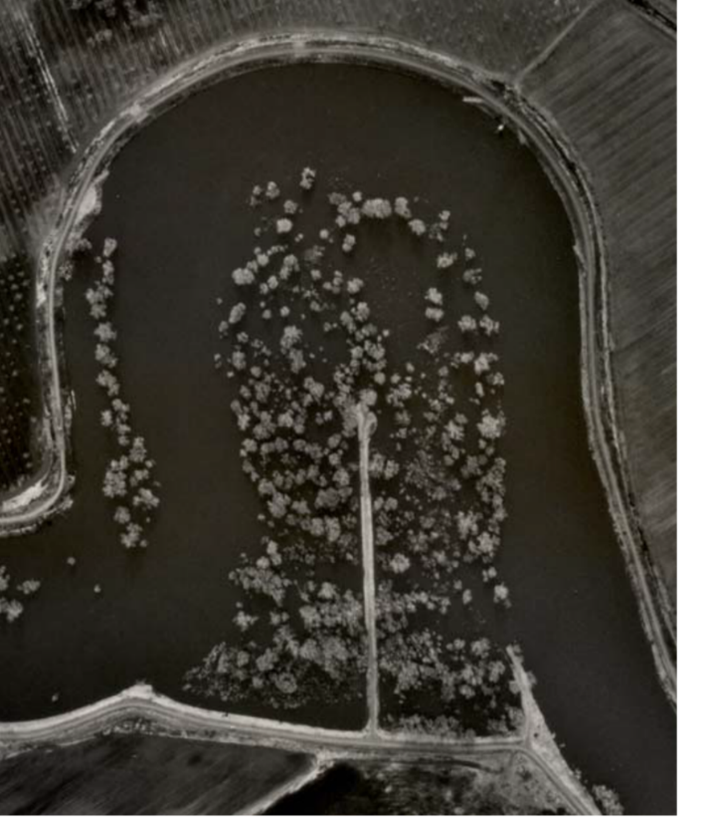
Aerial image of flood event on the Oxbow Preserve in 1997
The Project
Beginning in 2014, CNLM partnered with the California Department of Transportation to establish suitable native vegetative cover on the raised berm that provides the only high-ground on the Preserve during a large flood event. The project also established additional vegetation within the low-lying areas to provide connectivity between the berm and other vegetated areas. Since the inception of the Preserve, this area has been dominated by annual grass and a few small trees, providing little to no cover for RBR. Establishing native vegetation within this high ground was recognized as an essential need for protecting this critically endangered species. In 2020, CNLM entered into an agreement with California Department of Transportation (Caltrans) to fulfill Caltrans’ riparian brush rabbit mitigation obligations for the Tracy 205 Highway Widening Project. By implementing the Mitigation and Monitoring Plan for the High-Water Refugia Enhancement Project this project now provides refuge habitat for this species during periods of sustained flooding on the Preserve. The intent of the Project was to increase the available refugia cover on the elevated portions of the Preserve, as well as increase the connectivity of low ground habitat to these refugia areas. This raised area of the Preserve was enhanced with native shrubs, vines, and grasses to provide foraging opportunities for the riparian brush rabbit, as well as shelter from the elements, and cover from predators. Caltrans provided funding for the implementation of the 5-year project and an endowment that will provide perpetual funding to make this project sustainable in the future. As part of the project, CNLM recorded a Declaration of Restrictive Covenants on the Preserve, which furthers the goal of protecting this species.
Funds were used to secure necessary permits, establish a water source and provide for maintenance during the establishment period. By enhancing the vegetation and additional stewardship funding, this project has and will continue to provide necessary elements to protect RBR, ensuring survival during prolonged flood events. Additionally, with this funding CNLM has been able to increase security to minimize trespass as well as provide for population and occupancy studies utilizing remote cameras. With this partnership CNLM will be able to continue protection of the property and the RBR in perpetuity.
Public Access
Due to the vulnerability of the species and habitats that exist on this preserve, it is not open to the public.
Contact
For information about the Oxbow Preserve or Center for Natural Lands Management, please contact Preserve Manager, Erik Gantenbein, at 760.731.7790 extension 213 or email egantenbein@cnlm.org.